
Pacisco\Toulmin_Model
Pacisco is built around the forensic rhetorical model described by Stephen E. Toulmin (1922-2009) in his 1958 book, ‘The Uses of Argument’ [Toulmin 2003]. Based on analysis of the sort of practical arguments that take place in courtrooms, Toulmin identifies a number of elements that have specific functions in attempting to convince the hearer:
- the claim, that is being made or opposed
- grounds or evidence for the claim
- a warrant that explains the relevance of the evidence to the claim (often only implied rather than explicitly stated)
- backing for the warrant, giving it justification
- qualification, the strength or limitation of the warrant’s applicability
- rebuttal; exceptional circumstances that make the warrant inapplicable to the case
He employs a simple diagrammatic notation to illustrate the relations between these elements.
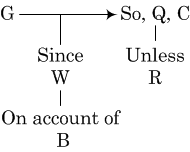
[Adapted from Toulmin p.97, ‘G’ replaces the original ‘D’ for datum.]
Where ‘G’ is the grounds on which the claim ‘C’ is based, justified by warrant ‘W’ with backing ‘B’. The warrant’s strength of application to this case is qualification ‘Q’, with exceptions rebuttal ‘R’.
 Pacisco: to agree