
Pacisco\Evaluative_mechanism
Pacisco contains a mechanism to assist the reader in forming a considered opinion of the validity of claims. It does not produce a definitive result, but is intended to help the debater to identify inconsistency in their reasoning and show where positions are controversial.
There is a collective element to the mechanism; assigned plausibility ratings of cases by all reviewers are combined to show a collective opinion. At the same time, a separate suggested rating of a particular claim by the individual reviewer is computed. Both the collective and individual suggested ratings are based on an algorithmic combination of the ratings of all cases for or against the claim (recursively computed from their subordinate claims). The reviewer is not required to adopt the suggested evaluation, but may choose to adjust ratings based on it and/or the collective rating. At the very least, large discrepancies between the individual reviewer’s prior and posterior ratings indicate inconsistency, and/or the collective rating indicate the presence of controversy. Elements of the algorithm are represented in the following diagram and described below.
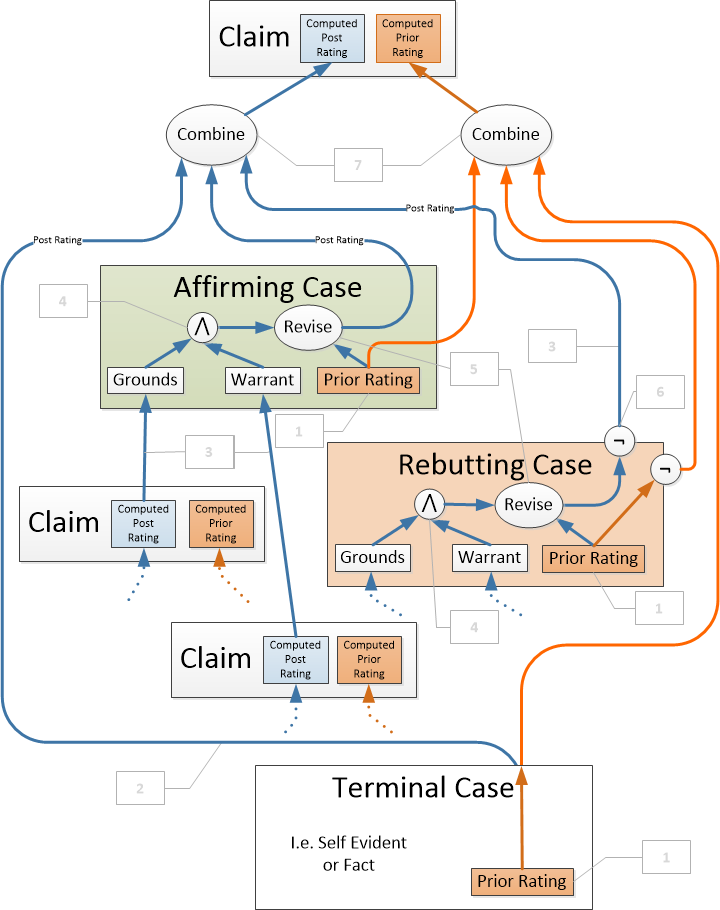
The method is described in the numbered ‘steps’ below, relating to the call-out numbers on the diagram:
- Prior-ratings are assigned.
- For Terminal Cases, the prior-rating becomes the post-rating.
- For Affirming and Rebutting Cases, the computed post-rating of the claims composing grounds and warrant are recursively computed.
- Ratings from grounds and warrant are combined conjunctively (AND’ed) as the ‘strength’ of the case.
- The case ‘strength’ is revised taking account of the prior-rating (damped) to produce the case post-rating.
- For rebutting cases, both the prior-rating and post-rating are negated.
- For all cases, prior-ratings and post-ratings are separately combined. The default method is that all cases are combined disjunctively (i.e. combined by the logical ‘or’ operator). Alternative methods available are to select only the strongest rating; alternatively to produce the average (mean) of all case ratings.
A rationale for these steps is given on this page following.
“A prudent man imbued with the scientific spirit will not claim that his present beliefs are wholly true, though he may console himself with the thought that his earlier beliefs were perhaps not wholly false.
I should regard an unchanging system of philosophical doctrines as proof of intellectual stagnation.
Philosophical progress seems to me analogous to the gradually increasing clarity of outline of a mountain approached through mist, which is vaguely visible at first, but even at last remains in some degree indistinct.”
— Bertrand Russell, The Basic Writings of Bertrand Russell (1961), Preface, xiv
 Pacisco: to agree